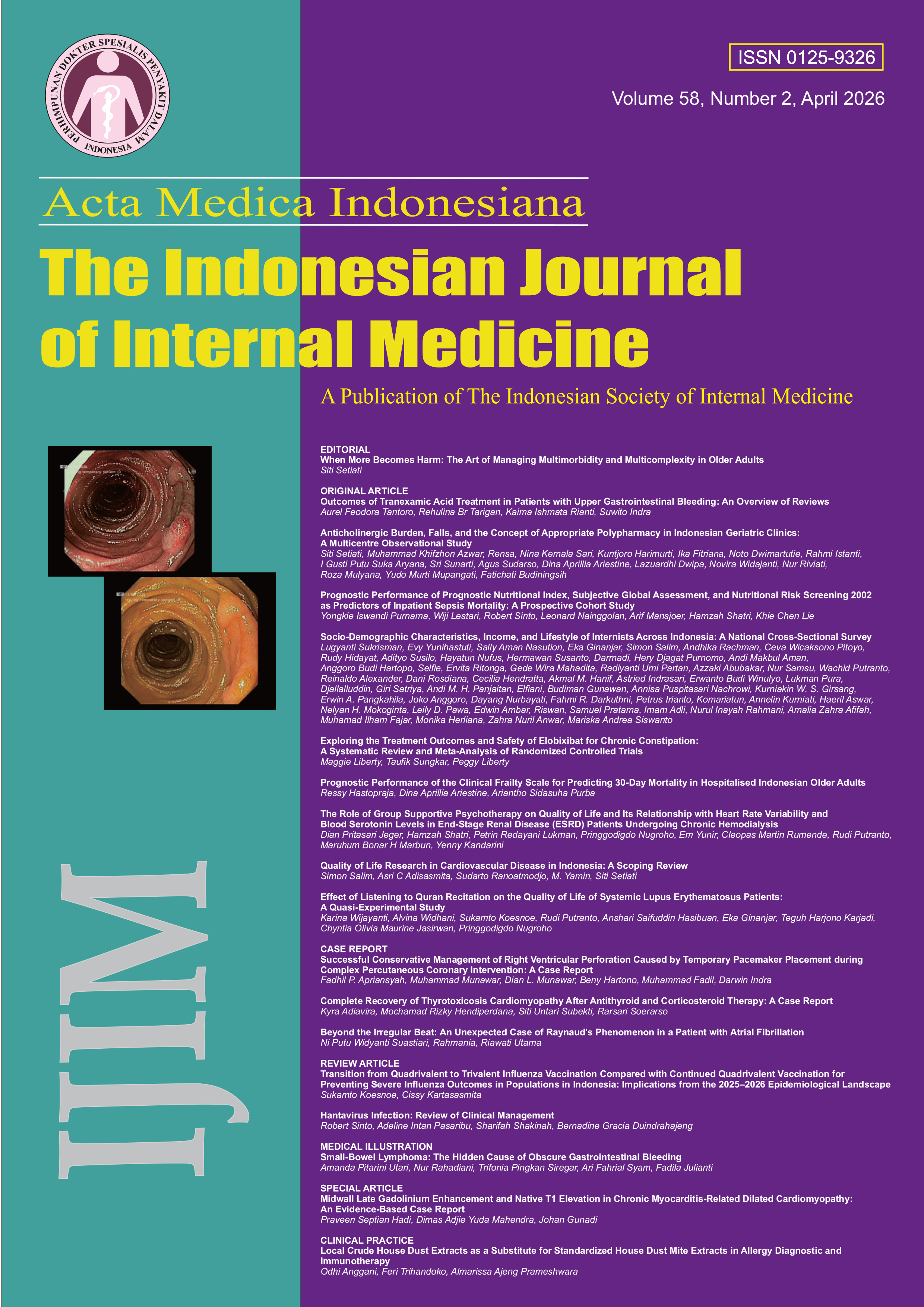
The Role of Group Supportive Psychotherapy on Quality of Life and Its Relationship with Heart Rate Variability and Blood Serotonin Levels in End-Stage Renal Disease (ESRD) Patients Undergoing Chronic Hemodialysis
Keywords:
End-sta, Group Supportive Psychotherapy, Hemodialysis, Heart Rate Variability, Quality of life, serotoninAbstract
Background: Patients with end-stage renal disease (ESRD) undergoing chronic hemodialysis often experience reduced quality of life and autonomic dysregulation. Group supportive psychotherapy may improve psychological well-being through biopsychosocial mechanisms. This study evaluated the effects of group supportive psychotherapy on quality of life and its association with heart rate variability (HRV) and blood serotonin levels. Methods: This randomized, parallel-group, single-blind controlled trial was conducted at the Hemodialysis Unit of Dr. Cipto Mangunkusumo National General Hospital, Jakarta, from November 2024 to January 2025. Fifty-two eligible patients were randomly assigned to an intervention group receiving group supportive psychotherapy plus standard care (n = 26) or a control group receiving standard care alone (n = 26). Outcomes were assessed at baseline and post-intervention using Kidney Disease Quality of Life-36 (KDQOL-36), HRV measured by standard deviation of normal-to-normal intervals (SDNN), and plasma serotonin levels measured using enzyme-linked immunosorbent assay (ELISA). Statistical analyses included an independent t-test or Mann-Whitney test, with effect size calculation and ANCOVA adjustment for baseline values. Results: The intervention group demonstrated significantly greater improvement in KDQOL-36 scores compared with control (mean change 8.46-16.92 vs 0.27-11.36; p=0.046). After adjustment, the between-group difference remained statistically significant (p<0.001), with a large effect size (Cohen’s d = 1.16). Plasma serotonin levels were significantly higher in the intervention at post-intervention (p=0.028; r=0.30). However, no significant differences were observed in HRV (SDNN) either between groups (p=0.805) or within groups over time (p>0.05). Conclusion: Group supportive psychotherapy significantly improves quality of life and is associated with higher plasma serotonin levels in ESRD patients undergoing chronic hemodialysis. However, no significant autonomic modulation, as measured by HRV, was demonstrated.References
Kidney Disease Improving Global Outcomes. Chapter 1: Definition and classification of CKD. Kidney Int Suppl (2011). 2013;3(1):19-62. doi:10.1038/kisup.2012.64
Ulya L, Krisbiantoro P, Hartinah D, Karyati S. Hubungan Durasi Hemodialisa dengan Tekanan Darah Pasien Gagal Ginjal Kronik di Ruang Hemodialisasi RSI Pati. Indonesia Jurnal Perawat. 2020;(1).
Wang Z, Luo Y, Zhang Y, et al. Heart rate variability in generalized anxiety disorder, major depressive disorder, and panic disorder: A network meta-analysis and systematic review. J Affect Disord. 2023;330:259-266. doi:https://doi.org/10.1016/j.jad.2023.03.018
Greenfield RH, Rindfleisch JA. HEART RATE VARIABILITY AND ARRHYTHMIAS. U.S. Department of Veterans Affairs. 2020. Accessed June 4, 2024. https://www.va.gov/WHOLEHEALTHLIBRARY/docs/Heart-Rate-Variability-and-Arrhythmias.pdf
Dale E, Pehrson AL, Jeyarajah T, et al. Effects of serotonin in the hippocampus: How SSRIs and multimodal antidepressants might regulate pyramidal cell function. CNS Spectr. Cambridge University Press. 2016;21(2):143-161. doi:10.1017/S1092852915000425
Mansouri S, Jalali A, Rahmati M, Salari N. Educational supportive group therapy and the quality of life of hemodialysis patients. Biopsychosoc Med. 2020;14(1). doi:10.1186/s13030-020-00200-z
Taylor F, Taylor C, Baharani J, Nicholas J, Combes G. Integrating emotional and psychological support into the end-stage renal disease pathway: A protocol for mixed methods research to identify patients’ lower-level support needs and how these can most effectively be addressed. BMC Nephrol. 2016;17(1). doi:10.1186/s12882-016-0327-2
Lam DY, Scherer JS, Brown M, Grubbs V, Schell JO. A conceptual framework of palliative care across the continuum of advanced kidney disease. Clinical Journal of the American Society of Nephrology. 2019;14(4):635-641. doi:10.2215/CJN.09330818
Lanini I, Samoni S, Husain-Syed F, et al. Palliative Care for Patients with Kidney Disease. J Clin Med. MDPI. 2022;11(13). doi:10.3390/jcm11133923
Sturgill D, Bear A. Unique Palliative Care Needs of Patients with Advanced Chronic Kidney Disease-the Scope of the Problem and Several Solutions. Vol 17. 2017. www.usrds.org/adr.aspx
Nugroho P, Wijaya S, Putranto R, Rumende CM, William D, Lydia A. Correlation of Body Composition and Quality of Life in Maintenance Hemodialysis Patients. Nephrourol Mon. 2022;14(4). doi:10.5812/numonthly-129587
Armaly Z, Farah J, Jabbour A, et al. Major depressive disorders in chronic hemodialysis patients in Nazareth: identification and assessment. Neuropsychiatr Dis Treat. 2012;8:329. doi:10.2147/NDT.S31903
Opland C, Torrico TJ. Psychotherapy and Therapeutic Relationship. StatPearls. Published online October 6, 2024. Accessed March 5, 2026. https://www.ncbi.nlm.nih.gov/books/NBK608012/
Parmar JS, Thapa P, Micheal S, et al. The Impact of a Peer Support Program on the Social and Emotional Wellbeing of Postgraduate Health Students During COVID-19: A Qualitative Study. Education Sciences 2025, Vol 15. 2025;15(3). doi:10.3390/educsci15030273
Lui F, Lewicka M, Bao GC, Moyer A, Boyce L, Leng J. A systematic review and meta-analysis of psychosocial interventions for immigrant and limited English proficient cancer patients. Psychooncology. 2023;32(4):516. doi:10.1002/pon.6110
Pham T, Lau ZJ, Chen SHA, Makowski D. Heart rate variability in psychology: A review of HRV indices and an analysis tutorial. Sensors. MDPI AG. 2021;21(12). doi:10.3390/s21123998
Kelsey TW, Miles A, Mitchell RT, Anderson RA, Wallace WHB. A normative model of serum inhibin B in young males. PLoS One. 2016;11(4):7-10. doi:10.1371/journal.pone.0153843
Panizo S, Martínez-Arias L, Alonso-Montes C, et al. Fibrosis in chronic kidney disease: Pathogenesis and consequences. Int J Mol Sci. MDPI AG. 2021;22(1):1-19. doi:10.3390/ijms22010408
Yang L, Humphreys BD, Bonventre J V. Pathophysiology of Acute Kidney Injury to Chronic Kidney Disease: Maladaptive Repair. In: C. Ronco, J-L. Vincent, J. A. Kellum, eds. Controversies in Acute Kidney Injury. Vol 174. KARGER; 2011:149-155. doi:https://doi.org/10.1159/isbn.978-3-8055-9811-8
Martínez-Hernández SL, Muñoz-Ortega MH, Ávila-Blanco ME, Medina-Pizaño MY, Ventura-Juárez J. Novel Approaches in Chronic Renal Failure without Renal Replacement Therapy: A Review. Biomedicines. Multidisciplinary Digital Publishing Institute (MDPI). 2023;11(10). doi:10.3390/biomedicines11102828
López-Novoa JM, Martínez-Salgado C, Rodríguez-Peña AB, Hernández FJL. Common pathophysiological mechanisms of chronic kidney disease: Therapeutic perspectives. Pharmacol Ther. 2010;128(1):61-81. doi:10.1016/j.pharmthera.2010.05.006
Hurtado K, Scholpa NE, Schnellmann JG, Schnellmann RG. Serotonin regulation of mitochondria in kidney diseases. Pharmacol Res. Academic Press. 2024;203. doi:10.1016/j.phrs.2024.107154
Karu N, McKercher C, Nichols DS, et al. Tryptophan metabolism, its relation to inflammation and stress markers, and association with psychological and cognitive functioning: Tasmanian Chronic Kidney Disease pilot study. BMC Nephrol. 2016;17(1):1-13. doi:10.1186/s12882-016-0387-3
Barišić I, Pivac N, Mück-Šeler D, Jakovljević M, Šagud M. Comorbid depression and platelet serotonin in hemodialysis patients. Nephron Clin Pract. 2004;96(1). doi:10.1159/000075566
Cook JA, Heller T, Pickett-Schenk SA. The Effect of Support Group Participation on Caregiver Burden among Parents of Adult Offspring with Severe Mental Illness. Vol 48. 1999. http://www.jstor.orgURL:http://www.jstor.org/stable/585248http://www.jstor.org/stable/585248?seq=1&cid=pdf-reference#references_tab_contents
Chien WT, Chan SWC, Thompson DR. Effects of a mutual support group for families of Chinese people with schizophrenia: 18-Month follow-up. British Journal of Psychiatry. 2006;189(JULY):41-49. doi:10.1192/bjp.bp.105.008375
Heller T, Roccoforte JA, Hsieh K, Cook JA, Pickett SA. Benefits of support groups for families of adults with severe mental illness. American Journal of Orthopsychiatry. American Psychological Association Inc. 1997;67(2):187-198. doi:10.1037/h0080222
Downloads
Published
How to Cite
Issue
Section
License
Copyright (c) 2026 Dian Pritasari Jeger, Hamzah Shatri, Petrin Redayani Lukman, Pringgodigdo Nugroho, Em Yunir, Cleopas Martin Rumende, Rudi Putranto, Maruhum Bonar H Marbun, Yenny Kandarini

This work is licensed under a Creative Commons Attribution 4.0 International License.
Copyright
The authors who publish in this journal agree to the following requirements:
- Authors retain copyright and grant the journal right of first publication with the work simultaneously licensed under a Creative Commons Attribution 4.0 International License (CC BY 4.0) that allows others to share the work with an acknowledgement of the work's authorship and initial publication in this journal.
- Authors can enter into separate, additional contractual arrangements for the non-exclusive distribution of the journal's published version of the work (e.g., post it to an institutional repository or publish it in a book), with an acknowledgement of its initial publication in this journal.
- Authors are permitted and encouraged to post their work online (e.g., in institutional repositories or on their website) before and during the submission process, as it can lead to productive exchanges, as well as earlier and greater citation of published work. (See The Effect of Open Access)
Privacy Statement
The names and email addresses entered in this journal site will be used exclusively for the stated purposes of this journal and will not be made available for any other purpose or to any other party.